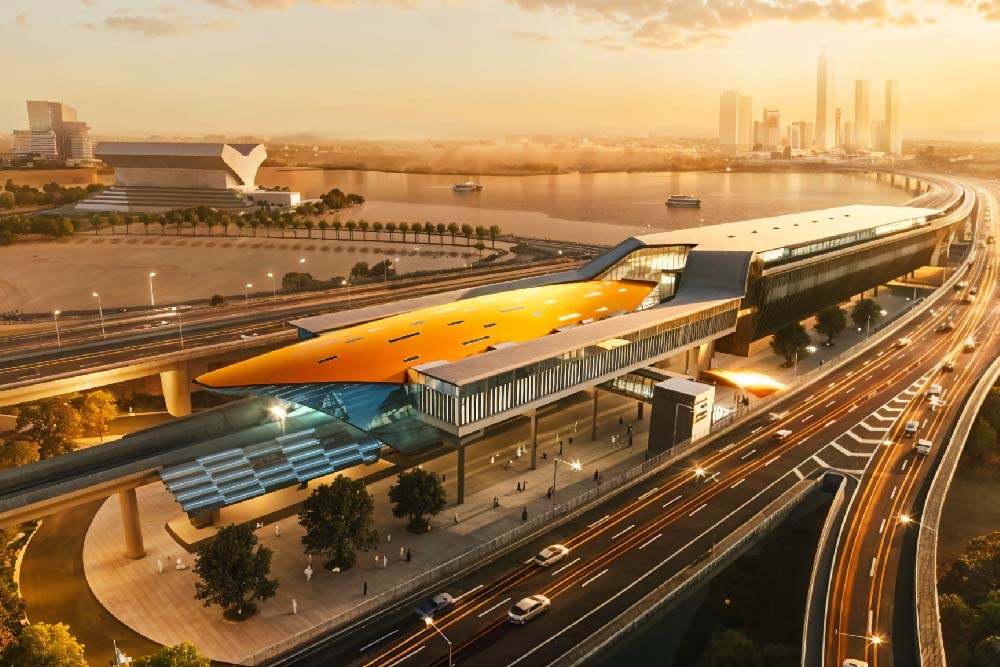
What if one infrastructure project could unlock up to 25% capital appreciation on your next investment? That’s precisely the opportunity emerging around Dubai’s Metro Blue Line, one of the most significant real estate growth triggers in the city’s current development cycle.
To put that into perspective, an AED 1 million investment today could potentially appreciate to AED 1.25 million, purely on the strength of enhanced connectivity and growing demand across these emerging corridors. This is more than just a metro expansion, it’s a strategic shift in how Dubai’s growth story is unfolding.
Backed by an AED 18 billion investment, this transformative project is set to connect Dubai’s key residential, commercial, and institutional hubs. This will reshape urban mobility and drive tangible value across the property market, making it an excellent entry point for early investors.
With construction already underway and full operations expected by 2029, this is not a distant prospect, it’s an evolving opportunity already in motion. Dubai’s population is expected to reach 7.8 million by 2040, and the demand for well-located, high-quality housing is only set to intensify. So, the real question isn’t whether you should invest, but rather, how quickly can you seize this opportunity?
Blue Line: Redefining Connectivity and Driving Market Momentum
Designed to integrate seamlessly with the city’s existing Red and Green Lines, the Blue Line will introduce 14 new stations, connecting emerging residential zones, commercial districts, and key lifestyle hubs.
Key upcoming stops include:
- Dubai Creek Harbour: A waterfront district already attracting high-end investment
- Dubai Festival City: A vibrant retail, dining and entertainment destination
- Ras Al Khor: An industrial zone with a distinctive ecological edge
- Dubai Silicon Oasis: A growing hub for tech-driven businesses and innovation
- Academic City: The city’s leading education cluster
- Mirdif City Centre: A well-established residential and retail micro-market
The metro will feature a network of AI-powered systems, real-time tracking, and energy-efficient stations designed to deliver smarter, faster, and more sustainable urban mobility. For daily commuters, the Blue Line means quicker, more convenient travel across the city. But for property investors, the impact will run deeper. Metro connectivity has consistently driven higher property values and stronger rental demand in every market it touches.
The Blue Line’s Impact on Dubai’s Property Market
If you consider global cities with highly integrated metro systems, one pattern is evident. Properties close to transit stations are valued higher and command more rental demand. Property values around metro lines have increased by 26.7% annually over the past decade, surpassing the city average. The Blue Line will also replicate the same trend, presenting huge investment prospects in previously underutilized areas.
Here’s what to look out for:
- Increased property value: Houses close to metro stations generally experience a 10-25% increase in price.
- Increased rental demand: Tenants will pay a premium for convenient metro access, resulting in improved ROI for landlords.
- New investment hotspots: Upcoming areas such as Dubai Creek Harbour and Silicon Oasis are soon going to experience massive real estate booms.
And it’s not just residential properties, commercial real estate will also thrive as companies seek prime locations near high-traffic metro stations. This growth aligns with the broader vision set out in Dubai’s Urban Master Plan 2040.
The Bigger Picture: Dubai’s 2040 Urban Master Plan
By improving accessibility and integrating key business and residential hubs, the Metro Blue Line aligns with Vision 2040’s goal of forging a future-proofed cityscape. Its role goes beyond transport, it supports a broader urban vision designed to elevate both quality of life and long-term investment value.
Key highlights of the Dubai 2040 Urban Master Plan include:
- 400% increase in public beach areas
- 134% expansion in hospitality and tourism zones
- 25% more space for education and healthcare infrastructure
- 55% of the population to live within 800 metres of a major public transport station
Together, these initiatives strengthen Dubai’s position as a high-growth real estate market and reinforce long-term investor confidence.
As construction advances, property prices along the Blue Line corridor are expected to continue their upward trajectory, making early investment not just strategic, but essential. Squarea is well-positioned to help you as an investor to capitalise on this momentum. We specialise in identifying high-growth opportunities across Dubai’s most promising investment zones. Whether you’re looking to invest, expand, or diversify your portfolio, our team of experts will guide you in securing the right asset before the market moves further.
The future of Dubai is moving, ensure your investment moves with it!

 The Beginning: When the Red Line Changed Dubai
On 9 September 2009, the Red Line launched - a bold step in a city known for highways and cars. What seemed experimental quickly became essential.
Connecting the airport to Deira, Downtown, Business Bay, Marina, Jebel Ali and later Expo City, it reshaped how Dubai moved - and how it grew.
Areas near stations saw rising demand, stronger occupancy, and increasing property values. Districts like Business Bay, Marina and Jebel Ali evolved into some of the city’s most connected hubs.
The Metro didn’t just support development.
It accelerated it.
The Green Metro Line Expanded Dubai Beyond the Main Corridor
Two years later, on 9 September 2011, the Green Metro Line began service, extending the Metro beyond the main business corridor and into the heart of everyday Dubai.
Connecting Deira, Bur Dubai, Al Qusais, Al Nahda and Dubai Healthcare City, it linked older, densely populated neighborhoods to the wider city, easing congestion and improving daily movement.
Infrastructure must expand ahead of population growth - not after congestion becomes unmanageable.
That philosophy now defines Dubai’s future metro strategy.
Dubai Metro by the Numbers: A System That Became Essential
Over time, Dubai Metro evolved from infrastructure into daily necessity.
Current Performance Highlights
The Beginning: When the Red Line Changed Dubai
On 9 September 2009, the Red Line launched - a bold step in a city known for highways and cars. What seemed experimental quickly became essential.
Connecting the airport to Deira, Downtown, Business Bay, Marina, Jebel Ali and later Expo City, it reshaped how Dubai moved - and how it grew.
Areas near stations saw rising demand, stronger occupancy, and increasing property values. Districts like Business Bay, Marina and Jebel Ali evolved into some of the city’s most connected hubs.
The Metro didn’t just support development.
It accelerated it.
The Green Metro Line Expanded Dubai Beyond the Main Corridor
Two years later, on 9 September 2011, the Green Metro Line began service, extending the Metro beyond the main business corridor and into the heart of everyday Dubai.
Connecting Deira, Bur Dubai, Al Qusais, Al Nahda and Dubai Healthcare City, it linked older, densely populated neighborhoods to the wider city, easing congestion and improving daily movement.
Infrastructure must expand ahead of population growth - not after congestion becomes unmanageable.
That philosophy now defines Dubai’s future metro strategy.
Dubai Metro by the Numbers: A System That Became Essential
Over time, Dubai Metro evolved from infrastructure into daily necessity.
Current Performance Highlights

