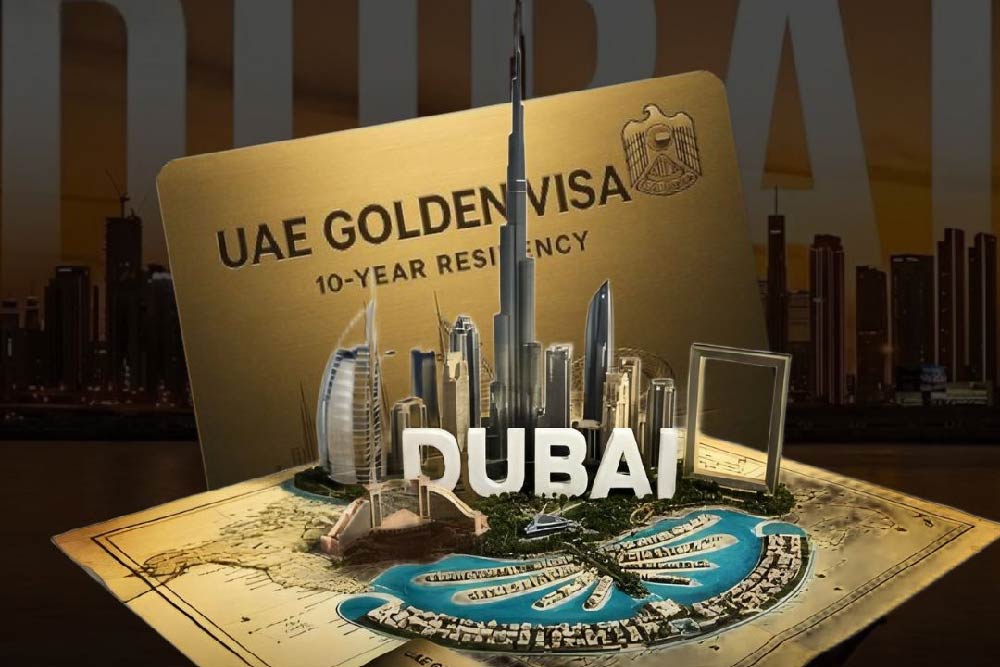
Over the past few years, Dubai has transformed from a regional real estate hub into one of the world’s most attractive long-term investment destinations. A major catalyst behind this surge is the property-linked residency program introduced by the government of Dubai.
Today, investors purchasing property worth AED 2 million or more can qualify for a 10-year renewable residency under the UAE Golden Visa, making real estate not just an asset but a pathway to long-term stability in one of the most dynamic economies in the world.
With strong rental yields, a tax-free environment, and increasing global demand, the Golden Visa has become a major driver of property transactions in the United Arab Emirates real estate market.
Why the Dubai Golden Visa Is Transforming Real Estate Investment
The residency-through-investment model has been adopted by several global destinations, but Dubai’s approach stands out for its simplicity, transparency, and investor-friendly policies.
Through property ownership, international investors can secure:
- 10-year renewable residency
- Freedom to live, work, and study in the UAE
- Ability to sponsor family members
- Access to world-class healthcare and education
- sA stable, tax-efficient economic environment
According to the Dubai Land Department, international investors now account for a significant share of property transactions, with Golden Visa eligibility becoming a key motivator for long-term buyers.
Property Investment Criteria for the Golden Visa
To qualify for the Golden Visa through real estate, investors must meet the following conditions:
Minimum Investment
- Property value of AED 2 million or more
Ownership Type
- Freehold residential property in designated investment zones
Financing Rules
- Mortgaged properties may qualify if AED 2 million equity is maintained
Property Status
- Completed or off-plan properties approved by authorities
The visa is issued after verification through government platforms coordinated by the Dubai Land Department and immigration authorities.
Why Investors Prefer Dubai for Residency-Linked Real Estate
While several countries offer residency through investment, Dubai stands apart due to a unique combination of economic, lifestyle, and regulatory advantages.
- Zero Property Taxes
Unlike many global markets, the UAE offers:
- No annual property tax
- No capital gains tax
- No inheritance tax
This allows investors to maximize long-term returns.
- Strong Rental Yields
Residential properties in Dubai often generate 8 – 10% average rental yields, with some high-demand areas reaching even higher returns.
Compared to major global cities:
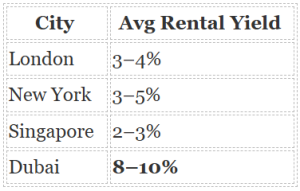
This combination of income + residency benefits makes Dubai particularly attractive to international investors.
Dubai consistently ranks among the world’s best cities for:
- Safety
- Connectivity
- Business environment
- Luxury lifestyle
Global entrepreneurs, professionals, and families increasingly choose Dubai as a primary or secondary residence, driving consistent demand in the housing market.
- Growing Demand from Global Investors
Investors from Europe, Asia, Africa, and North America are entering the market due to:
- Currency diversification
- Political and economic stability
- Strategic geographic location between East and West
The Golden Visa has significantly accelerated this trend.
Best Property Segments for Golden Visa Investors
For investors targeting residency eligibility, the following property types are particularly popular:
Luxury Apartments
High-rise developments in central locations offering strong rental demand.
Waterfront Residences
Premium properties with lifestyle appeal and strong capital appreciation.
Branded Residences
Hotel-style living developed in partnership with luxury brands.
These asset classes often combine capital growth, rental income, and residency eligibility, making them ideal for global investors.
The Long-Term Outlook for Golden Visa Real Estate
Dubai’s real estate market continues to benefit from:
- Population growth
- Infrastructure expansion
- Business migration
- Government investor-friendly policies
Major masterplans and economic diversification initiatives across the UAE are expected to support continued demand in the coming decade.
For investors seeking both wealth creation and global mobility, property investment linked to the Golden Visa represents one of the most compelling opportunities in international real estate today.
Final Thoughts
The introduction of the Golden Visa has fundamentally reshaped the way investors view Dubai real estate. What was once purely a financial investment has now become a gateway to long-term residency, lifestyle benefits, and global opportunity.
As Dubai continues to strengthen its position as a leading global city, investors entering the market today are not just purchasing property—they are securing a stake in one of the world’s fastest-growing economic hubs.

 The Beginning: When the Red Line Changed Dubai
On 9 September 2009, the Red Line launched - a bold step in a city known for highways and cars. What seemed experimental quickly became essential.
Connecting the airport to Deira, Downtown, Business Bay, Marina, Jebel Ali and later Expo City, it reshaped how Dubai moved - and how it grew.
Areas near stations saw rising demand, stronger occupancy, and increasing property values. Districts like Business Bay, Marina and Jebel Ali evolved into some of the city’s most connected hubs.
The Metro didn’t just support development.
It accelerated it.
The Green Metro Line Expanded Dubai Beyond the Main Corridor
Two years later, on 9 September 2011, the Green Metro Line began service, extending the Metro beyond the main business corridor and into the heart of everyday Dubai.
Connecting Deira, Bur Dubai, Al Qusais, Al Nahda and Dubai Healthcare City, it linked older, densely populated neighborhoods to the wider city, easing congestion and improving daily movement.
Infrastructure must expand ahead of population growth - not after congestion becomes unmanageable.
That philosophy now defines Dubai’s future metro strategy.
Dubai Metro by the Numbers: A System That Became Essential
Over time, Dubai Metro evolved from infrastructure into daily necessity.
Current Performance Highlights
The Beginning: When the Red Line Changed Dubai
On 9 September 2009, the Red Line launched - a bold step in a city known for highways and cars. What seemed experimental quickly became essential.
Connecting the airport to Deira, Downtown, Business Bay, Marina, Jebel Ali and later Expo City, it reshaped how Dubai moved - and how it grew.
Areas near stations saw rising demand, stronger occupancy, and increasing property values. Districts like Business Bay, Marina and Jebel Ali evolved into some of the city’s most connected hubs.
The Metro didn’t just support development.
It accelerated it.
The Green Metro Line Expanded Dubai Beyond the Main Corridor
Two years later, on 9 September 2011, the Green Metro Line began service, extending the Metro beyond the main business corridor and into the heart of everyday Dubai.
Connecting Deira, Bur Dubai, Al Qusais, Al Nahda and Dubai Healthcare City, it linked older, densely populated neighborhoods to the wider city, easing congestion and improving daily movement.
Infrastructure must expand ahead of population growth - not after congestion becomes unmanageable.
That philosophy now defines Dubai’s future metro strategy.
Dubai Metro by the Numbers: A System That Became Essential
Over time, Dubai Metro evolved from infrastructure into daily necessity.
Current Performance Highlights

