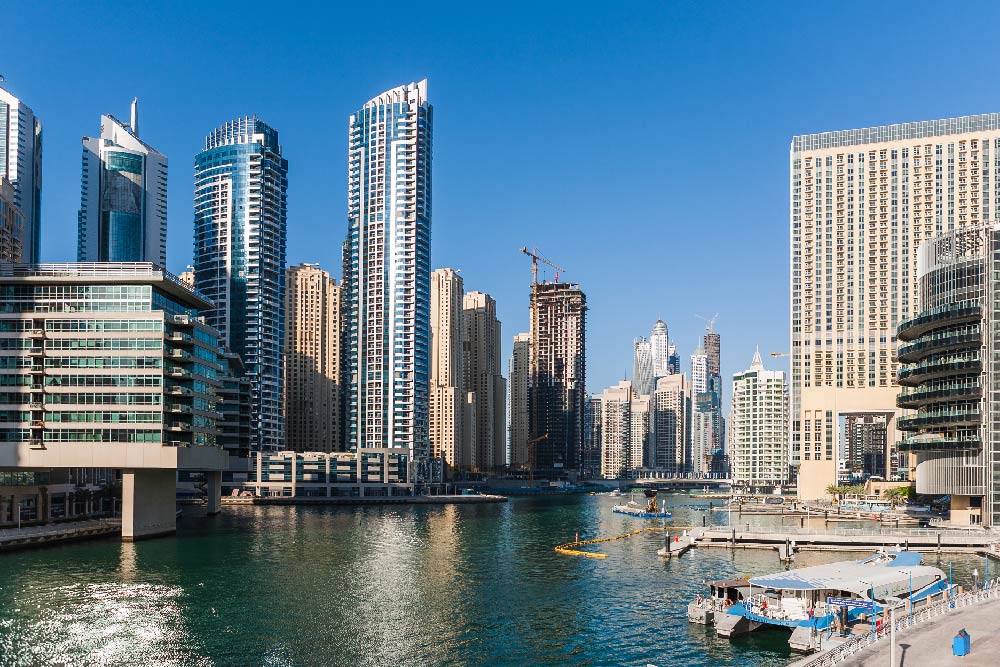
For decades, property has remained one of the most reliable vehicles for wealth creation across the world. In the Middle East, particularly in Dubai and the wider United Arab Emirates, real estate has evolved into a globally recognized investment asset class.
Driven by high rental yields, world-class infrastructure, investor-friendly regulations, and a tax-efficient environment, the UAE property market continues to attract investors from across the globe, from first-time buyers to high-net-worth individuals.
Unlike many financial instruments that fluctuate heavily with global markets, real estate combines tangible asset ownership with recurring income and long-term capital appreciation. With rapid population growth, economic diversification, and continuous infrastructure expansion, UAE real estate stands out as one of the most balanced and resilient long-term investment options.
In this article, we explore why property investment in the UAE continues to outperform many traditional investment avenues and what investors should know before entering the market.
High Rental Yields That Outperform Global Markets
One of the strongest drivers behind real estate investment in the UAE is exceptional rental performance.
In major districts such as Business Bay, Dubai Marina, and Jumeirah Village Circle, average gross rental yields typically range between 8% and 12% annually, significantly higher than many global real estate markets.
For comparison:
- London: ~3–4%
- New York: ~3–5%
- Singapore: ~2–4%
- Dubai: 8–10%
This makes Dubai one of the top rental yield markets globally.
Investors also have the flexibility to generate income through multiple rental models:
Long-Term Rentals
- Stable tenants
- Consistent annual income
Short-Term Holiday Rentals
- Higher nightly returns
- Strong demand from tourists and business travellers
Tourism growth, global events, and a thriving expatriate workforce continue to ensure steady tenant demand, keeping vacancy levels relatively low in popular residential districts.
Long-Term Capital Appreciation
While rental income offers immediate returns, capital appreciation remains the most powerful wealth builder in real estate.
Dubai’s property prices are heavily influenced by infrastructure expansion, urban planning, and new master communities.
Major developments such as:
have historically seen strong price growth once infrastructure, retail zones, and transport links are fully operational.
Properties purchased during early development stages, particularly off-plan projects – often experience significant value increases between launch and handover.
This allows investors to benefit from both capital appreciation and rental income once the property is completed.
Tax-Free Investment Environment
Another major factor driving global investor interest is the UAE’s highly tax-efficient system.
Unlike many international markets, the UAE offers:
- No property tax
- No capital gains tax
- No tax on rental income
- No inheritance tax on property assets
This means investors retain a significantly larger portion of their returns compared to markets where property taxation can reach 20 – 40% of profits.
The only primary costs investors need to account for include:
- Registration Fees or Property transfer fees
- Service charges
- Agency commissions if applicable
Even with these expenses, net returns remain highly competitive compared to global property markets.
Investor-Friendly Ownership Laws
The UAE has implemented strong regulatory frameworks to protect property investors and increase transparency.
Foreign buyers can now own freehold properties in designated investment zones across Dubai.
This provides investors with:
- Full ownership rights
- The ability to sell, lease, or transfer the property
- Legal protection under UAE property laws
Additionally, investors purchasing property worth AED 2 million or more qualify for the long-term residency program under the UAE Golden Visa.
This residency benefit allows investors and their families to live in the UAE for extended periods, adding lifestyle advantages to financial returns.
Strong Economic Growth Driving Property Demand
Real estate performance is closely linked to the broader economy, and the UAE has built one of the most diversified and stable economies in the region.
Key sectors driving growth include:
- Tourism
- International trade
- Financial services
- Technology
- Logistics
- Aviation
Dubai alone attracts millions of visitors annually and continues to draw professionals and entrepreneurs from around the world.
Population growth driven by expatriate migration creates continuous housing demand, which directly supports both rental markets and property prices.
Large-scale global events such as Expo 2020 Dubai have further accelerated investment in infrastructure and global connectivity.
Real Estate as a Hedge Against Inflation
During periods of inflation, the value of money decreases – but tangible assets like real estate often increase in value.
As construction costs, land prices, and rental demand rise, property prices typically follow the same upward trend.
This makes real estate an effective inflation hedge, helping investors preserve and grow their wealth over time.
Compared to equities or speculative assets, property tends to be less volatile and more stable, especially in mature and regulated markets such as Dubai.
Risks and Considerations for Investors
While the long-term outlook remains positive, investors should always approach real estate with careful planning.
Some factors to consider include:
Market Cycles
Like any asset class, real estate experiences periodic cycles of growth and correction.
Oversupply in Certain Districts
Rapid development in some areas may temporarily increase competition in the rental market.
High Entry Costs
Initial investments typically include:
- Down payment
- Registration fees
- Brokerage charges
Lower Liquidity
Property cannot be sold instantly like stocks, so investors should adopt a medium to long-term investment horizon.
However, with the right project selection and location analysis, these risks can be effectively managed.
Why UAE Real Estate Stands Out Compared to Other Investments
When compared with traditional investment instruments such as stocks, bonds, or gold, real estate in the UAE offers a unique combination of advantages:
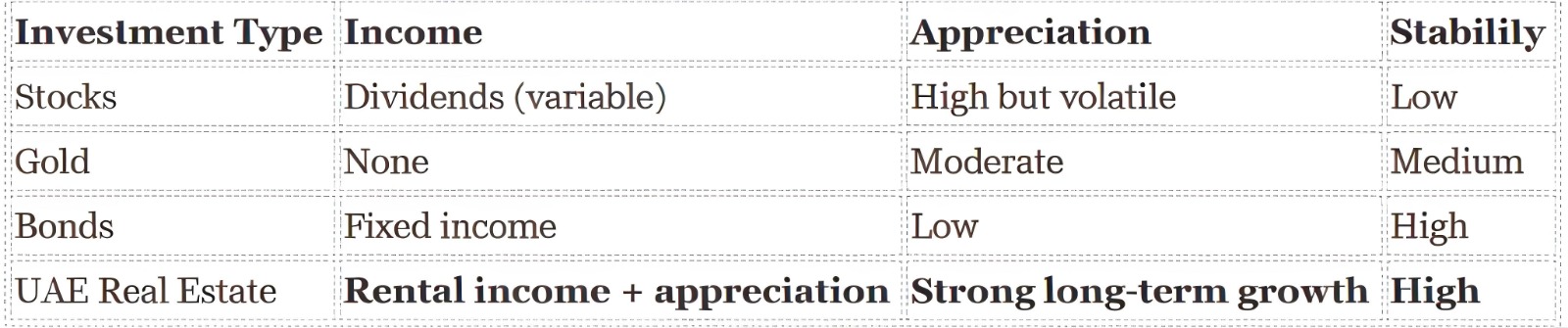
[Text Wrapping Break]This combination of income generation, capital growth, and asset security is why property continues to be a preferred wealth-building tool for investors.
Insights
UAE real estate continues to attract investors worldwide due to its strong fundamentals and long-term growth potential.
Key advantages include:
- High rental yields compared to global markets
- Long-term capital appreciation supported by infrastructure development
- A tax-free investment environment that maximizes net returns
- Strong expatriate population growth sustaining housing demand
- Investor-friendly regulations and freehold ownership opportunities
- Tangible asset stability and inflation protection
While every investment carries risks, the UAE property market remains one of the most attractive real estate investment destinations globally.
For investors seeking a balanced combination of income, growth, and long-term wealth preservation, UAE real estate continues to stand among the most compelling opportunities.

 The Beginning: When the Red Line Changed Dubai
On 9 September 2009, the Red Line launched - a bold step in a city known for highways and cars. What seemed experimental quickly became essential.
Connecting the airport to Deira, Downtown, Business Bay, Marina, Jebel Ali and later Expo City, it reshaped how Dubai moved - and how it grew.
Areas near stations saw rising demand, stronger occupancy, and increasing property values. Districts like Business Bay, Marina and Jebel Ali evolved into some of the city’s most connected hubs.
The Metro didn’t just support development.
It accelerated it.
The Green Metro Line Expanded Dubai Beyond the Main Corridor
Two years later, on 9 September 2011, the Green Metro Line began service, extending the Metro beyond the main business corridor and into the heart of everyday Dubai.
Connecting Deira, Bur Dubai, Al Qusais, Al Nahda and Dubai Healthcare City, it linked older, densely populated neighborhoods to the wider city, easing congestion and improving daily movement.
Infrastructure must expand ahead of population growth - not after congestion becomes unmanageable.
That philosophy now defines Dubai’s future metro strategy.
Dubai Metro by the Numbers: A System That Became Essential
Over time, Dubai Metro evolved from infrastructure into daily necessity.
Current Performance Highlights
The Beginning: When the Red Line Changed Dubai
On 9 September 2009, the Red Line launched - a bold step in a city known for highways and cars. What seemed experimental quickly became essential.
Connecting the airport to Deira, Downtown, Business Bay, Marina, Jebel Ali and later Expo City, it reshaped how Dubai moved - and how it grew.
Areas near stations saw rising demand, stronger occupancy, and increasing property values. Districts like Business Bay, Marina and Jebel Ali evolved into some of the city’s most connected hubs.
The Metro didn’t just support development.
It accelerated it.
The Green Metro Line Expanded Dubai Beyond the Main Corridor
Two years later, on 9 September 2011, the Green Metro Line began service, extending the Metro beyond the main business corridor and into the heart of everyday Dubai.
Connecting Deira, Bur Dubai, Al Qusais, Al Nahda and Dubai Healthcare City, it linked older, densely populated neighborhoods to the wider city, easing congestion and improving daily movement.
Infrastructure must expand ahead of population growth - not after congestion becomes unmanageable.
That philosophy now defines Dubai’s future metro strategy.
Dubai Metro by the Numbers: A System That Became Essential
Over time, Dubai Metro evolved from infrastructure into daily necessity.
Current Performance Highlights

