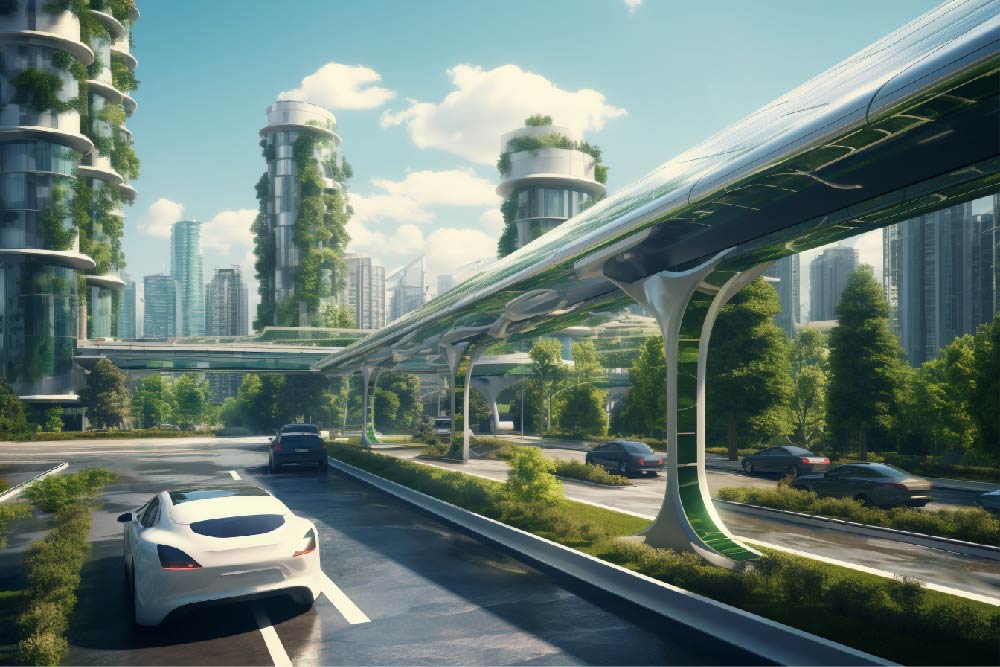
The UAE’s 2030 Green Mobility Initiative marks a defining moment in the evolution of urban infrastructure and real estate. Focused on sustainability and efficiency, it reimagines how residents move, connect, and live. From autonomous vehicles and air taxis to the Etihad Rail network, the plan transforms transport into the cornerstone of sustainable urban growth.
Anchored within the UAE’s broader Green Agenda 2030 and its commitment to net zero emissions by 2050, this initiative is shaping a future where mobility and environmental design drive real estate value. For investors, it opens a new lens – where opportunity lies not just in location, but in alignment with sustainability, technology, and long-term policy vision.
Transport And Connectivity: The New Drivers Of Real Estate Value
Proximity to transport networks is now one of the most powerful influences on property performance in the UAE. Developments near infrastructure such as the Etihad Rail, Dubai Metro extensions, and autonomous transport corridors are seeing growing demand and appreciation.
- Accessibility drives demand: Properties near transit hubs enjoy stronger rental and resale potential.
- Reduced car dependency: Transit-oriented neighbourhoods encourage walkability and improve livability.
- Smart connectivity: Features like EV charging and app-based mobility enhance convenience and value.
As the UAE builds its connected future, infrastructure is not just shaping cities, it’s reshaping what buyers and tenants value most.
Changing Buyer And Tenant Preferences
Homebuyers and tenants today are increasingly conscious of sustainability, convenience, and community design. The demand for walkable, transit-linked, and environmentally responsible neighbourhoods has grown sharply across Dubai and Abu Dhabi.
Developments with shaded walkways, cycle paths, EV-ready parking, and sustainable amenities appeal to both residents and global investors. For tenants, this combination of green transport access and eco-efficient design ensures comfort, savings, and a stronger sense of belonging.
This shift in mindset is encouraging developers to create integrated communities where mobility, sustainability, and liveability meet seamlessly.
Sustainable Community Development: Where Urban Design Meets Green Living
The UAE is home to pioneering examples of sustainable community planning, led by Masdar City in Abu Dhabi and Sharjah Sustainable City. These developments combine renewable energy, smart infrastructure, and sustainable transport systems to create self-sufficient neighbourhoods.
- Renewable energy and recycling systems support net-zero goals
- Smart water management reduces consumption and improves efficiency
- Integrated mobility solutions limit emissions and enhance accessibility
Such projects showcase the next phase of urban development, where green design improves quality of life and strengthens long-term property value. The UAE’s firm commitment to green building standards across all new developments reinforces this evolution.
Green Building Standards And Retrofitting For The Future
The UAE’s Green Building Codes are guiding principles for sustainable construction. Developers are increasingly adopting energy-efficient materials, improved insulation, and smart lighting to meet these standards.
For existing buildings, retrofitting presents a major opportunity. Upgrades like solar panels, water-efficient systems, and digital energy controls not only reduce costs but also attract ESG-conscious tenants and institutional investors.
Government incentives and certification programs further motivate developers to integrate sustainability into every stage of construction, turning compliance into a competitive advantage. That alignment of policy and innovation has created new avenues for investment and financing.
Investment And Financing Opportunities In Green Real Estate
Green finance is fast becoming a core pillar of Dubai’s real estate market. Banks and government-backed institutions now offer preferential financing for projects that use renewable energy, smart resource management, and sustainable construction methods.
For investors, such properties deliver measurable advantages:
- Higher occupancy and tenant retention rates
- Lower long-term operating costs
- Increased institutional and global investor interest
Sustainability has evolved from a marketing term into a defining benchmark of value. Projects that integrate green design and technology are proving more resilient and desirable across market cycles. This shift is also influencing how cities themselves are planned.
Urban Planning And Market Transformation
Green mobility is transforming the cities of the UAE. Urban planning is increasingly incorporating EV charging grids, autonomous transport systems, and integrated cycling corridors as standard elements.
This approach enhances efficiency, reduces congestion, and improves liveability, all of which strengthen real estate demand. Properties located in these connected, future-ready zones are expected to outperform in both appreciation and rental yield.
This makes green mobility not only an environmental strategy but also an economic one, building cities that are both sustainable and globally competitive.
Economic And Environmental Objectives
The UAE’s sustainability roadmap aims to boost GDP growth, expand exports, and lower carbon emissions through clean energy and mobility innovation. The 2030 Green Mobility Initiative plays a direct role in achieving these goals by cutting transport-related emissions and improving logistics efficiency.
For the real estate market, this alignment between economic ambition and environmental progress drives long-term investor confidence and asset appreciation. Sustainability and growth are now inseparable forces shaping the UAE’s urban future.
The Road Ahead: Sustainability As The New Benchmark Of Value
The UAE’s 2030 Green Mobility Initiative is more than a transport plan. It’s a blueprint for sustainable urban evolution. For developers, investors, and residents, the message is clear: sustainability and accessibility are now central to real estate success.
Properties that integrate mobility access, smart technology, and environmental responsibility will continue to define the next generation of value creation. Dubai’s model shows how long-term planning, innovation, and governance can align to create a resilient, investor-trusted real estate ecosystem.
At SQUAREA, we connect investors with Dubai’s most future-ready properties, from sustainable master-planned communities to premium developments along key mobility corridors. Each asset in our portfolio is curated for its lasting value, design excellence, and alignment with the UAE’s 2030 vision.
For personalised investment guidance, reach us at hello@squarea.io or call +91 90 9641 9641

 The Beginning: When the Red Line Changed Dubai
On 9 September 2009, the Red Line launched - a bold step in a city known for highways and cars. What seemed experimental quickly became essential.
Connecting the airport to Deira, Downtown, Business Bay, Marina, Jebel Ali and later Expo City, it reshaped how Dubai moved - and how it grew.
Areas near stations saw rising demand, stronger occupancy, and increasing property values. Districts like Business Bay, Marina and Jebel Ali evolved into some of the city’s most connected hubs.
The Metro didn’t just support development.
It accelerated it.
The Green Metro Line Expanded Dubai Beyond the Main Corridor
Two years later, on 9 September 2011, the Green Metro Line began service, extending the Metro beyond the main business corridor and into the heart of everyday Dubai.
Connecting Deira, Bur Dubai, Al Qusais, Al Nahda and Dubai Healthcare City, it linked older, densely populated neighborhoods to the wider city, easing congestion and improving daily movement.
Infrastructure must expand ahead of population growth - not after congestion becomes unmanageable.
That philosophy now defines Dubai’s future metro strategy.
Dubai Metro by the Numbers: A System That Became Essential
Over time, Dubai Metro evolved from infrastructure into daily necessity.
Current Performance Highlights
The Beginning: When the Red Line Changed Dubai
On 9 September 2009, the Red Line launched - a bold step in a city known for highways and cars. What seemed experimental quickly became essential.
Connecting the airport to Deira, Downtown, Business Bay, Marina, Jebel Ali and later Expo City, it reshaped how Dubai moved - and how it grew.
Areas near stations saw rising demand, stronger occupancy, and increasing property values. Districts like Business Bay, Marina and Jebel Ali evolved into some of the city’s most connected hubs.
The Metro didn’t just support development.
It accelerated it.
The Green Metro Line Expanded Dubai Beyond the Main Corridor
Two years later, on 9 September 2011, the Green Metro Line began service, extending the Metro beyond the main business corridor and into the heart of everyday Dubai.
Connecting Deira, Bur Dubai, Al Qusais, Al Nahda and Dubai Healthcare City, it linked older, densely populated neighborhoods to the wider city, easing congestion and improving daily movement.
Infrastructure must expand ahead of population growth - not after congestion becomes unmanageable.
That philosophy now defines Dubai’s future metro strategy.
Dubai Metro by the Numbers: A System That Became Essential
Over time, Dubai Metro evolved from infrastructure into daily necessity.
Current Performance Highlights

